


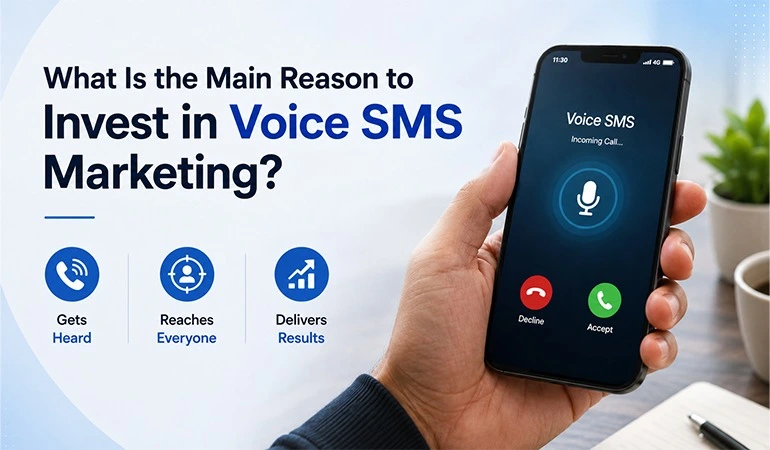
Voice SMS marketing has become a practical communication channel for businesses that need to reach customers quickly and clearly. Unlike text-based messages, Voice SMS delivers information through a recorded voice call, making it useful when a message needs more attention or when customers may not read an SMS.
For businesses, the main reason to invest in Voice SMS marketing is simple: it helps deliver important messages directly to customers in a personal and easy-to-understand format.
With Voice SMS, companies can communicate promotions, reminders, alerts, offers, payment notifications and other business information without depending entirely on customers opening an app or reading a long message.
What Is Voice SMS Marketing?
Voice SMS marketing is a communication method where businesses send a pre-recorded voice message to a large number of customers or contacts.
The recipient receives the call and hears the recorded message. The content can be prepared in advance and delivered according to a campaign schedule.
Voice SMS can be useful for:
• Promotional campaigns
• Customer reminders
• Event invitations
• Payment reminders
• Appointment notifications
• Service updates
• Political and public awareness campaigns
• Product announcements
• Emergency alerts
• Customer follow-ups
The message can also be recorded in regional languages, which can make communication easier for audiences who are more comfortable listening than reading.
What Is the Main Reason to Invest in Voice SMS Marketing?
The biggest reason to invest in Voice SMS marketing is direct customer communication.
A text message requires the customer to read it. A voice message allows the business to communicate the information through speech. This can be especially valuable when the message is urgent, detailed, or intended for audiences with different reading preferences.
Voice communication can also add a human element to a campaign. A carefully recorded message can sound more natural than a standard promotional text.
For example, a local business announcing a limited-time offer can use a short voice message to explain the offer, mention the validity period and provide a clear call to action.
Why Voice SMS Can Be Valuable for Businesses
1. Direct and Simple Communication
Voice SMS reduces the need for customers to read lengthy text. They can simply listen to the message.
This makes it suitable for short announcements, reminders, alerts and promotional messages where quick understanding matters.
2. Supports Regional Languages
Businesses serving customers across different regions can record messages in languages that their audiences understand comfortably.
Regional-language communication can make campaigns more accessible and relevant, particularly for local businesses and mass-market campaigns.
3. Useful for Large-Scale Campaigns
Voice SMS can help businesses communicate with a large customer base without requiring individual calls from employees.
A single recorded message can be distributed to thousands of recipients as part of a planned campaign.
4. Suitable for Reminders and Alerts
Some messages need attention at the right time. Appointment reminders, payment reminders, delivery updates and event notifications are examples.
Voice SMS can make these communications easier to notice than messages that may remain unread in a crowded inbox.
5. Adds a Personal Touch
Hearing a voice can make communication feel more direct. Businesses can use a professional voice recording, a familiar representative's voice, or a regional-language recording depending on the campaign.
Voice SMS vs. Traditional Text Communication
Text SMS remains useful for short information such as OTPs, links and brief notifications. However, some messages are easier to understand when they are spoken.
Voice SMS can be considered when:
• The audience may prefer listening to reading.
• The message contains several details.
• A reminder needs stronger attention.
• Regional-language communication is important.
• The business wants to deliver a more personal message.
• The campaign requires large-scale calling without manual calling.
The right choice depends on the purpose of the communication. In many campaigns, Voice SMS can work alongside SMS, WhatsApp, email and other channels.
2 Practical Use Cases of Voice SMS Marketing
Use Case 1: Retail and E-commerce Promotions
Suppose an online retailer is running a weekend sale. Instead of relying only on written promotional messages, the business can send a short voice message informing customers about the offer.
The recording can mention the discount, sale period, product category and website or store name. This gives customers the key information in a few seconds.
Use Case 2: Appointment and Payment Reminders
Clinics, service providers, financial businesses, educational institutes and other organizations regularly need to remind customers about appointments or pending payments.
A voice reminder can clearly mention the date, time, amount, or required action. This can reduce dependence on manual reminder calls and help maintain regular customer communication.
2 Case Studies of Voice SMS Marketing
Case Study 1: Local Retail Chain
A retail chain wanted to promote a regional festival offer across several customer segments. The company created short Voice SMS recordings in the languages commonly spoken by its customers.
The messages focused on the offer, store location and campaign dates. Instead of using one lengthy recording, the business created separate versions for different customer groups.
The approach helped the company communicate the campaign in a familiar format while reducing the need for staff to make individual promotional calls.
Case Study 2: Education and Training Institute
An education institute needed to follow up with prospective students who had shown interest in its courses.
The institute used Voice SMS to send short reminders about counselling sessions, admission deadlines and scheduled calls. Students received the information directly through recorded messages.
This created a consistent follow-up process and allowed the institute's team to spend more time handling serious enquiries instead of repeatedly making routine reminder calls.
How to Create an Effective Voice SMS Campaign
A successful Voice SMS campaign depends heavily on the quality and relevance of the recording.
Follow these practices:
• Keep the message short and focused.
• Introduce the business clearly.
• Speak at a comfortable speed.
• Use simple language.
• Mention the most important information first.
• Include one clear action for the recipient.
• Use regional languages where appropriate.
• Avoid unnecessary background noise.
• Send messages to relevant and permission-based audiences.
• Review the recording before launching the campaign.
A good voice message should sound like useful communication rather than a long advertisement.
Why Choose Voice SMS for Business Communication?
Businesses today communicate with customers through several channels. The challenge is making sure important information reaches people in a form they can easily understand.
Voice SMS provides another direct communication option. It can be particularly useful for businesses that serve large customer groups, operate in multiple languages, or need to send reminders and announcements at scale.
When planned properly, Voice SMS can support marketing, customer service, follow-ups and notification campaigns from one communication channel.
Frequently ask questions
Voice SMS marketing is a communication method where businesses send recorded voice messages to customers through automated calls.
Yes. Businesses can use Voice SMS for offers, product announcements, event promotions, seasonal campaigns and customer re-engagement.
Yes. Businesses can create recordings in different languages to communicate more comfortably with regional audiences.
Yes. Appointment reminders, payment reminders, event notifications, service updates and other time-sensitive communications are common uses.
Voice SMS gives businesses a direct way to communicate information through recorded speech. It can support large-scale outreach while reducing the need for manual calls.