


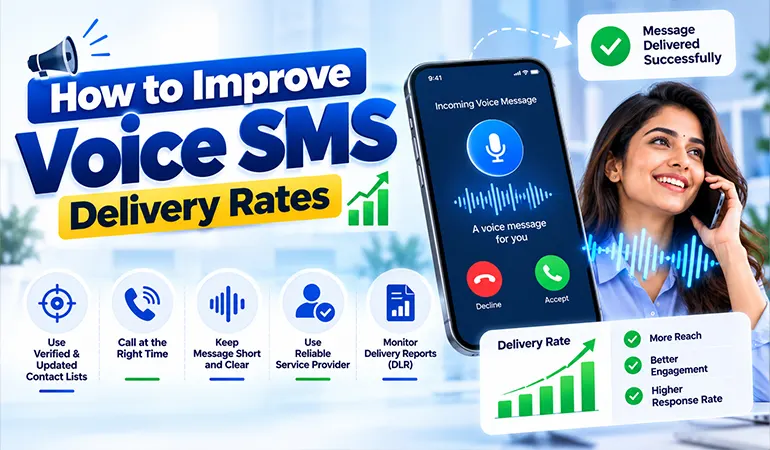
A voice message is useful only when it reaches the intended audience at the right time. Businesses use Voice SMS to share payment reminders, appointment updates, promotional announcements, delivery information and important alerts. When a large number of calls fail to connect, these messages may not reach customers as planned.
Low delivery rates can result from incorrect phone numbers, poor network coverage, busy lines, call screening, unsuitable sending times, or problems with the calling system. In some cases, the call connects, but the recipient disconnects before hearing the complete message.
Improving delivery rates requires more than increasing the number of calls. Businesses need accurate contact lists, clear recordings, reliable calling infrastructure and regular performance checks. Voice SMS campaigns become easier to manage when each part of the delivery process is monitored carefully.
What Is a Voice SMS Delivery Rate?
A Voice SMS delivery rate measures how successfully voice messages reach their intended recipients. However, the exact definition depends on the reporting system used by the service provider.
For example, one platform may count a call as successful when the recipient's phone rings or the call connects. Another may distinguish between answered calls, completed playback and calls that reach voicemail.
Businesses should understand these differences before comparing campaign results.
A useful set of metrics includes:
- Call attempt rate: The proportion of intended calls submitted to the calling system.
- Connection rate: The proportion of attempted calls that connect successfully.
- Answer rate: The proportion of calls answered by recipients.
- Playback completion rate: The proportion of connected calls in which the message plays to completion, where tracking is available.
- Failure rate: The proportion of calls that fail to connect or complete according to the provider's reporting definitions.
These metrics help identify where a campaign is losing potential recipients.
Common Reasons for Low Voice SMS Delivery Rates
1. Incorrect or Inactive Phone Numbers
Outdated contact lists are a common source of failed calls. Customers may change numbers, enter incorrect digits in registration forms, or provide landline numbers that cannot receive the intended automated voice service.
Businesses should validate contact details when collecting them and remove permanently invalid numbers from future campaigns.
2. Poor Network Coverage
A recipient may be travelling, working in a low-signal area, or temporarily outside network coverage. The phone may also be switched off or unavailable.
These conditions can prevent calls from connecting even when the contact number is correct. Reviewing failure reports by time and destination can help identify recurring network-related problems.
3. Unfavourable Calling Times
Customers may be less likely to answer automated calls during working hours, late at night, or while commuting. Calling at inconvenient times can also lead to complaints and blocked numbers.
Choose calling times that suit the audience, the message's urgency and applicable calling rules. Time-sensitive alerts may need a different schedule from promotional announcements.
4. Unclear or Overly Long Recordings
A call that connects can still fail to achieve its purpose if the recording is difficult to understand. Long introductions, fast speech, poor audio quality and unnecessary details can cause recipients to disconnect early.
A good voice message should explain who is calling, why the recipient is being contacted and what action is required.
5. Calling System or Routing Problems
Technical issues within the voice messaging platform, telecom network, or routing configuration can affect call completion. Sudden increases in campaign volume may also expose capacity limits.
A reliable provider should offer useful call reports, clear failure statuses and support for investigating recurring delivery problems.
10 Ways to Improve Voice SMS Delivery Rates
1. Maintain an Accurate Contact Database
Start by checking the quality of the phone numbers used in each campaign. Even a well-configured voice messaging system cannot reach a customer through an invalid number.
Practical steps include:
- Remove duplicate contacts.
- Check phone number formats and country codes.
- Correct obvious data entry errors.
- Remove numbers confirmed as inactive.
- Update records when customers provide new details.
Collect contact information through legitimate channels and respect requests to stop receiving communications.
2. Use a Reliable Voice SMS Service Provider
Your service provider plays an important role in call routing, campaign processing, delivery reporting and troubleshooting. Compare providers based on their actual capabilities rather than relying on broad claims about delivery percentages.
When evaluating a provider, check for:
- Stable calling infrastructure.
- Appropriate telecom routing options.
- Detailed call status reports.
- Support for campaign scheduling.
- Capacity to handle your expected call volume.
- Technical assistance when delivery drops.
Voice SMS can be used for different campaign types, so confirm that the provider supports your specific requirements.
3. Record Clear and Professional Voice Messages
Audio quality affects whether customers understand the information and stay on the call. Record messages in a quiet environment using a suitable microphone and a steady speaking pace.
Keep the message focused on one main purpose. Avoid lengthy greetings, repeated information and technical terms that your audience may not understand.
Before launching a campaign, listen to the recording on different phones and check its volume, pronunciation and clarity.
4. Personalise Messages Where Appropriate
A relevant message is more likely to hold the recipient's attention than a generic recording. Where the system supports safe personalisation, include details such as a customer's name, appointment date, or order reference.
For example, an appointment reminder can state the scheduled date and time instead of simply asking the recipient to contact the business.
Use personal information only when necessary and avoid announcing sensitive details in a message that others might hear.
5. Choose Suitable Calling Times
Plan campaigns around the audience's routine and the purpose of the message. Appointment reminders may be useful a day before a booking, while a payment reminder may need to follow a clearly communicated schedule.
For larger audiences, divide the campaign into manageable groups and review performance across different time periods.
Always follow applicable regulations, permitted calling hours, consent requirements and customer preferences.
6. Keep Voice Messages Short and Direct
Recipients may disconnect if they must listen to a long recording before understanding its purpose. A short message makes the key information easier to follow.
A practical structure is:
- Introducing the business.
- Explain the reason for the call.
- Share the essential information.
- State the next action.
- Provide a suitable support option.
For example, a delivery company can briefly explain that a parcel is scheduled for delivery and direct the customer to an approved channel for further assistance.
7. Monitor Delivery Reports Regularly
Do not evaluate a campaign only by the number of calls submitted. Review connection rates, answer rates, call duration, playback completion where available and failure reasons.
Look for patterns such as:
- A sudden rise in unanswered calls.
- Repeated failures to particular destinations.
- Short calls that suggest early disconnection.
- Problems that begin after a system change.
- Lower completion rates during specific time slots.
Accurate reporting helps teams identify the right corrective action instead of repeatedly sending calls without understanding the problem.
8. Set Sensible Retry Rules
A failed call does not always mean the number is invalid. The recipient may have been busy or temporarily unavailable.
Where the platform and applicable rules permit retries, set reasonable limits and waiting periods. Avoid repeatedly calling the same person within a short time.
Use failure statuses to guide the next step. A temporary failure may justify another attempt, while a confirmed invalid number should normally be removed from the campaign list.
9. Improve Caller Identification and Trust
People are less likely to answer calls they do not recognise, especially when they receive frequent unwanted calls. Businesses should use authorised calling identities and maintain consistent, transparent communication practices.
Where supported, configure appropriate caller identification and business details. Never use misleading caller IDs or attempt to disguise promotional calls as personal calls.
Explain the purpose of the call early in the recording. This helps recipients decide whether the information is relevant to them.
10. Test Campaigns Before Sending at Scale
A small test campaign can reveal recording errors, incorrect contact fields, routing problems and scheduling issues before they affect a larger audience.
Test with authorised numbers across relevant devices and networks. Check that the recording starts correctly, information is accurate and the intended call status appears in the reporting system.
After the test, correct the issues and expand the campaign gradually. Continue monitoring performance as the volume increases.
The Role of Voice SMS in Reliable Business Communication
Businesses often use more than one communication channel to reach customers. Voice SMS can be useful when spoken instructions are more suitable than a text message, particularly for reminders, announcements and customers who may benefit from hearing information.
Voice SMS operates in the business messaging sector, where dependable communication and campaign monitoring are important. Businesses exploring voice messaging solutions should assess their contact data, campaign objectives, technical requirements and reporting needs before choosing a service.
A well-managed campaign should focus on reaching the right recipients, delivering a clear message, respecting customer preferences and measuring meaningful outcomes.
Practical Use Cases of Voice SMS
Use Case 1: Payment Reminders for Financial Services
A financial services company needs to remind customers about upcoming payment dates. Its team uses Voice SMS to deliver short reminders with the due date and instructions for checking payment details through an official channel.
The company segments its contact list, schedules calls at suitable times and monitors connection and playback reports. Customers who cannot be reached can receive a permitted follow-up through another communication channel.
This approach helps the team organise reminders and identify customers who may need additional assistance.
Use Case 2: Appointment Reminders for Clinics
A clinic wants to reduce missed appointments and the time staff spend making manual reminder calls.
It uses Voice SMS to share appointment dates, timings and instructions for contacting the reception team. Calls are scheduled in advance and the clinic monitors answer rates and appointment attendance.
The clinic can use these findings to adjust its reminder schedule and improve its booking process.
Case Studies: Improving Voice SMS Campaign Performance
Case Study 1: An E-commerce Business Improves Delivery Notifications
Challenge: An online retailer receives customer complaints about missed delivery updates. Its contact database contains duplicate numbers and its voice recordings include unnecessary information.
Solution: The retailer cleans its contact list, shortens its recording, identifies the purpose of each call early and reviews delivery reports after each campaign.
Measurement: The team tracks connection rates, playback completion where available, customer enquiries and delivery-related complaints.
Learning: Better data quality and clearer recordings can help reduce avoidable failures and make delivery notifications easier to understand.
This is an illustrative scenario. No verified client results or specific percentage improvements are claimed.
Case Study 2: An Educational Institute Optimises Admission Reminders
Challenge: An educational institute uses voice calls to remind prospective students about counselling sessions and admission deadlines. Many calls go unanswered and staff cannot easily identify the reasons.
Solution: The institute separates contacts by appointment date, tests different suitable calling times and uses shorter recordings with clear instructions. It also reviews call failure statuses and applies limited retries where appropriate.
Measurement: The team compares connection rates, completed message playback, counselling attendance and enquiries received after the campaign.
Learning: Audience segmentation, appropriate timing and regular reporting can help an institute manage its communication process more effectively.
This scenario is illustrative and does not represent a documented customer engagement.
Frequently Asked Questions
What is a good Voice SMS delivery rate?
A good rate depends on the audience, destination network, campaign type and provider's reporting method. Establish a baseline from previous campaigns and compare connection, answer and playback completion rates separately.
Why do Voice SMS calls fail?
Common reasons include invalid phone numbers, switched-off devices, poor network coverage, busy lines, call screening and technical routing issues. Review failure reports to identify the likely cause.
Does a higher answer rate mean better delivery?
Not necessarily. Answer rate measures how many calls recipients answer, while delivery and playback metrics may measure different stages. Track each metric separately to understand campaign performance.
How long should a Voice SMS recording be?
Keep it as short as the message allows. State the business name, purpose, essential information and next step without unnecessary introductions or repeated details.
How often should failed calls be retried?
Use limited retries based on the failure status, message urgency, customer preferences and applicable rules. Avoid repeatedly calling recipients who remain unavailable or have asked not to be contacted.
FAQs
A good rate depends on the audience, destination network, campaign type and provider's reporting method. Establish a baseline from previous campaigns and compare connection, answer and playback completion rates separately.
Common reasons include invalid phone numbers, switched-off devices, poor network coverage, busy lines, call screening and technical routing issues. Review failure reports to identify the likely cause.
Not necessarily. Answer rate measures how many calls recipients answer, while delivery and playback metrics may measure different stages. Track each metric separately to understand campaign performance.
Keep it as short as the message allows. State the business name, purpose, essential information and next step without unnecessary introductions or repeated details.
Use limited retries based on the failure status, message urgency, customer preferences and applicable rules. Avoid repeatedly calling recipients who remain unavailable or have asked not to be contacted.