


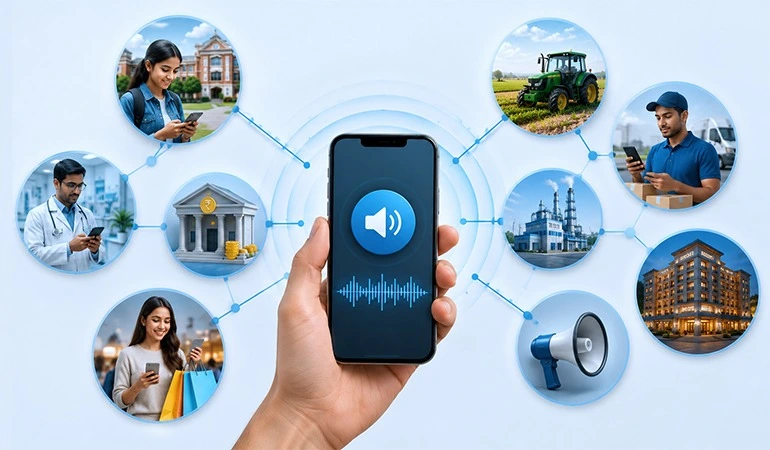
Voice SMS Use Cases Across Different Industries
In today's world, every business aims to reach its customers quickly, reliably and effectively. Relying solely on SMS or email is no longer sufficient, as there is no guarantee that a recipient will read the message immediately.
This is where Voice SMS emerges as a powerful communication tool. It allows a pre-recorded or text-to-speech-generated voice message to be delivered to thousands or even millions of people simultaneously within minutes. Customers simply need to answer the call to hear the message; no internet connection or smartphone is required.
From banking, healthcare, education and e-commerce to government services and real estate, almost every industry is leveraging Voice SMS to connect more effectively with customers.
Why is the Demand for Voice SMS Growing Across Industries?
Capturing customer attention has become more challenging than ever. Emails often go unnoticed and text messages frequently remain unread.
Voice SMS offers a solution by delivering the message directly to the customer through a phone call.
Key reasons include:
• The message is heard immediately.
• Effective in both rural and urban areas.
• Works without an internet connection.
• Messages can be sent in local languages.
• Important information is delivered more reliably.
• Easy to run large-scale campaigns simultaneously.
Key Use Cases of Voice SMS Across Various Industries
1. Healthcare Industry
Timely communication is crucial in healthcare services. Voice SMS facilitates better communication between patients and hospitals.
Uses:
• Doctor appointment reminders
• Vaccination notifications
• Health camp information
• Medication reminders
• Medical report availability alerts
• Emergency health messages
This ensures patients reach the hospital on time and reduces missed appointments.
2. Banking and Financial Services
Delivering secure and timely information to customers is crucial in the banking sector.
Uses of Voice SMS:
• EMI reminders
• Loan due alerts
• KYC updates
• Investment scheme information
• Insurance renewal reminders
• Branch-related notifications
Receiving messages in the local language helps customers understand the information better.
3. Education Industry
Schools, colleges and coaching institutes use Voice SMS to convey information to thousands of students and parents.
Uses:
• Exam dates
• Fee reminders
• Holiday notifications
• Parent-teacher meetings
• Admission updates
• Result announcements
This ensures information reaches everyone on time.
4. E-commerce Industry
In online shopping, it is essential to keep customers informed at every stage.
Uses of Voice SMS:
• Order confirmations
• Delivery updates
• Cash-on-delivery notifications
• Offers and sales
• Festive discounts
• Feedback requests
This helps build customer trust.
5. Real Estate Industry
Real estate companies use Voice SMS to reach a large number of potential buyers.
Key uses:
• New project launches
• Site visit invitations
• Price updates
• Offers
• Booking notifications
• Investment opportunities
Voice SMS serves as an effective medium to connect directly with potential customers.
6. Government Sector
Government departments use Voice SMS to convey important messages to a large number of citizens.
Examples:
• Government schemes
• Election-related information
• Weather warnings
• Disaster alerts
• Health campaigns
• Public announcements
This proves to be extremely effective, especially in rural areas.
7. Retail Business
Retail stores use Voice SMS to inform their customers about new offers and discounts.
Key use cases:
• Seasonal sales
• Festival offers
• Membership renewal
• Loyalty programs
• Store openings
• Flash sales
8. Travel and Tourism
In the travel industry, providing timely information to customers is crucial.
Use cases:
• Ticket confirmations
• Travel reminders
• Hotel booking updates
• Travel instructions
• Weather updates
• Offers
9. Logistics and Courier
Courier companies use Voice SMS to inform customers about the status of their parcels.
Examples:
• Shipment updates
• Delivery confirmations
• Delivery attempts
• Address verification
• Pickup reminders
10. Automobile Industry
Automobile companies adopt Voice SMS to enhance customer service.
Use cases:
• Service reminders
• Insurance renewals
• Test drive invitations
• New model launches
• Exchange offers
Key Benefits of Voice SMS
Voice SMS is not merely a medium for sending messages; it is also an effective way to boost customer engagement.
Key benefits:
• Information reaches instantly.
• No need for reading.
• Works even without the internet.
• Compatible with all types of mobile phones.
• Supports local languages.
• Easy to run large-scale campaigns.
• Better customer response.
• Saves both time and cost.
2 Key Use Cases of Voice SMS
Use Case 1: Vaccination Campaign by a Hospital
A district hospital sent Voice SMS messages to thousands of parents prior to a child vaccination drive.
The message clearly stated the vaccination date, time and location.
Results:
• More parents arrived on time.
• Vaccination participation increased.
• The hospital's manual calling workload was significantly reduced.
Use Case 2: Real Estate Project Launch
A real estate company sent Voice SMS messages to potential customers before launching a new project.
The message provided details regarding the launch date, special offers and site visits.
Results:
• More people booked site visits.
• There was a significant increase in inquiries.
• The marketing campaign yielded better results.
2 Case Studies on Voice SMS
Case Study 1: EMI Reminder Campaign by a Bank
A private bank relied on a call centre to remind a large number of customers about their EMI payments every month.
Strategy:
The bank implemented Voice SMS and began sending automated voice messages to customers three days before the payment due date.
Results:
• On-time EMI payments increased.
• Call centre workload decreased.
• Customers began receiving clear information on time.
• Communication costs were reduced.
Case Study 2: Coaching Institute Admission Campaign
A large coaching institute needed to convey information to thousands of students during the admission process.
Strategy:
The institute used Voice SMS to share details regarding admission deadlines, scholarship schemes and counselling schedules.
Results:
• Admission inquiries saw a significant increase.
• Students and parents received information at the right time.
• The need for manual calling was reduced.
• The admission process became more organised.
Tips for a Successful Voice SMS Campaign
Keep the following points in mind for the best results:
• Keep the message between 20 and 40 seconds long.
• Use clear and simple language.
• Record the message in the local language.
• Clearly state your brand name at the beginning.
• Include a clear Call to Action.
• Run the campaign at the right time.
• Use verified customer mobile numbers.
• Analyse campaign reports afterwards.
Which Businesses Benefit Most from Voice SMS?
Voice SMS is beneficial for businesses across almost every industry.
• Hospitals
• Banks
• Insurance companies
• Schools and colleges
• E-commerce businesses
• Real estate companies
• Government departments
• Travel agencies
• Logistics companies
• Retail stores
• Automobile companies
• NGOs
• Microfinance institutions
• Telecom companies
Frequently ask questions
Voice SMS is an automated calling service that delivers a pre-recorded voice message to multiple recipients simultaneously through phone calls.
Healthcare, Banking, Education, Real Estate, Retail, E-commerce, Government, Logistics, Automobile and Travel are among the major industries using Voice SMS.
Yes. Voice SMS operates on standard mobile networks and does not require an internet connection.
Yes. Businesses can record and send Voice SMS messages in Hindi, English or any regional language according to their audience.
Voice SMS enables faster communication, better customer engagement, wider reach, reduced operational costs and more effective delivery of important information.